The Denver Model: A City Manager's Guide to Transforming Resident Engagement with AI
National Awards and Recognition
Denver reshaped resident engagement with artificial intelligence. It's important to highlight the city’s leadership on the national stage—recognized in 2025 with several of the public sector’s highest honors for digital innovation and transformative use of technology. The City and County of Denver received the prestigious 2025 CIO 100 Award, honoring just 100 organizations nationwide that demonstrate outstanding achievement in deploying information technology for business value and public impact. This accolade recognizes not only technical prowess but strategic vision, as technology leaders from across the country gather annually at the CIO 100 Symposium & Awards to share breakthroughs in innovation, efficiency, and service delivery.In addition, Denver was named an inaugural winner of the Center for Public Sector AI’s AI 50 distinction. This program recognizes the top organizations blazing new trails in the use of artificial intelligence to transform state and local government, spotlighting trailblazers who deliver measurable results for residents. Denver’s AI-powered chatbot “Sunny” was most notably honored among government AI deployments for making city services instantly accessible in 72 languages, drastically lowering 311 hold times, and setting a new benchmark for digital accessibility and equity in the public sector.
Summary
This case study explores how city, county, and state government leaders are using AI-powered chat solutions to revolutionize the way residents access information and services. Focusing on the success story of the City and County of Denver’s chatbot, “Sunny,” it examines the challenges of multilingual communication, digital accessibility, and operational efficiency for public agencies. Through direct insights from leaders at Citibot and the City of Denver, the case study offers practical guidance on deploying AI chatbots, highlights the profound impact on resident engagement, and lays out best practices for implementation. Readers will find compelling evidence, actionable recommendations, and thought leadership on how AI—and Citibot in particular—is reshaping the resident-government relationship.
Key Conclusions
Denver’s AI chatbot, Sunny, has dramatically improved resident access to information, allowing over 95,000 residents to obtain answers and services in more than 45 languages, with over 100,000 questions answered and 5,000 service requests filed since March 2022.Multichannel access through website, SMS, and WhatsApp means 24/7 multilingual support for residents, creating more equitable service—especially for Spanish-speaking migrants and other language communities.AI-powered chat reduced costs by more than 90% per interaction, with each AI conversation costing roughly $0.35 compared to the $4 average for a human, freeing up resources for municipalities and delivering faster support.Implementation does not require extensive IT infrastructure. Citibot’s team works directly with city staff to deploy, integrate, and maintain the chatbot, usually by a small cross-functional team.Integration with systems such as Salesforce automates the routing of service requests, eliminating bottlenecks and ensuring residents’ needs reach the right departments swiftly.Real-time data dashboards allow city managers and communications directors to understand trends in resident inquiries, identify information gaps, and make data-driven decisions for improved services.Continuous learning: Resident feedback and interaction data guide the expansion and refinement of chatbot capabilities, letting cities evolve swiftly to meet changing needs.Maintaining control: Sunny use only curated, city-approved data sources, ensuring accuracy and authority in resident communication.Key Quote“Sunny has engaged over 95,000 residents, answered over 100,000 questions, and filed over 5,000 service request cases. We’ve seen 90% satisfaction. And if Sunny can’t answer the question, a resident can easily message a 311 agent for additional help. Don’t overthink it. This is a very easy and smooth process.”
—Rich Karbowiak, Marketing Technology Manager, City and County of Denver
How Government Leaders Use AI to Help Residents Connect and Get Answers
Connecting Communities in Real-Time: Why Accessibility MattersWhen it comes to community engagement, city and county governments have always faced a daunting challenge: how to connect with tens of thousands of residents who speak dozens of languages, are always on the move, and expect instant answers. In Denver, that challenge was compounded by the city’s 50+ independently operating agencies, a sprawling web presence of over 2,500 pages, and an influx of new Spanish-speaking migrants drawn by economic shifts and crisis events.
Rich Karbowiak, Denver’s Marketing Technology Manager, reflects on the past: “We had residents who simply couldn’t find what they were looking for, and with our agencies operating so autonomously, information was scattered.” That gap led to frustration for both residents and city staff, compounded by ballooning call volumes to Denver’s 311 service and growing pressure to reduce costs.That challenge crystallized during the recent migrant crisis, when Denver city leaders realized that traditional outreach wasn’t reaching key communities. “WhatsApp became essential,” recalls Rich. “For Spanish-speaking migrants, it was the platform of choice. To truly serve our community, we had to engage them where they were—not where we hoped they’d go.”
Sunny’s Arrival: An AI-Powered Bridge
Enter Sunny, Denver’s Citibot-powered AI chatbot. Launched in March 2022, Sunny was designed with one simple mission: make city information and services universally accessible, regardless of time, language, or digital literacy. Accessible 24/7 on the city website, SMS, and WhatsApp, Sunny allows residents to obtain answers, submit service requests, or check on city programs in their preferred language—instantly.The impact was immediate and striking. In just over two years, Sunny has engaged more than 95,000 residents, answered over 100,000 questions, and submitted more than 5,000 service requests. Interactions are available in over 45 languages—a number that surprised even the city’s planners, who initially anticipated support for just five to ten major languages.“For many residents, especially recent migrants, even calling 311 or reading an English-language website was a barrier,” says Rich. “Now someone can text in Polish, Somali, or Vietnamese; get an answer immediately; or start a service request completely in their own language. That builds trust in a way no static web page can.”
The Economics of Instant Answers
Efficiency gains have been equally transformative. Each interaction with Sunny costs the city about $0.35, compared to $4 for a 311 call—an order-of-magnitude savings that enables Denver to reinvest those dollars in critical services and new programs. And Sunny never sleeps; it processes requests long after the city’s physical offices close for the night, delivering on the promise of a city that is truly “always on.”“Resident expectations have changed,” explains Mary Frances Coryell of Citibot. “People want the same always-connected, app-free convenience from their city as they get from their bank or favorite retailer. Citibot was built from the ground up to deliver that experience—securely, reliably, and in whatever language a resident prefers.”The cost savings, Rich notes, are only the start: “With AI handling routine questions and requests, our staff can focus on the complex, human challenges. That’s a win for both sides.”
From Implementation to Integration: Lessons for City Managers
One of the most surprising aspects of the Sunny rollout, according to both Denver and Citibot, was just how simple the technical implementation proved. “This isn’t a major IT project,” Mary Frances emphasizes. “A cross-functional team of about five people got it launched. The heavy lifting—the AI models, natural language processing, web integrations—remains under the hood. The Citibot team handles setup, security, and ongoing customization.”Citibot’s approach is CMS-agnostic, with the chatbot integrated by a single line of code into existing municipal websites. Data ownership remains with the city, securely hosted in the Amazon cloud and protected by enterprise-grade standards.Integration with Salesforce allows service requests submitted through Sunny to be routed automatically to the appropriate department, with no manual triage, delay, or possibility for lost requests. The system can even ingest new press releases, web pages, or FAQ updates automatically, keeping answers accurate and up to date.As Rich puts it: “You’re not siloing information or adding a shadow database. The integration honors your existing tech stack.”
The Power of Data and Real-Time Insight
Beyond convenience, the true value of AI chat for government manifests in the data. Every resident question becomes a datapoint, allowing cities to spot trends, identify underserved groups, and close information gaps as never before. Language analytics helped Denver discover that demand for Polish, Vietnamese, and other linguistic support far outstripped initial estimates.“Before, we could only guess at what residents wanted,” Rich says. “Now, with Citibot’s data dashboard, we see exactly which topics are trending, which languages are used, and where we need to update our web content or service workflows.”Monthly, quarterly, and annual reports from Citibot’s client success team provide ongoing insight, while dashboards are available in real time to city leaders and communications teams.
Key Learnings and Advice for Peers
Denver’s experience with Sunny and Citibot offers a roadmap for other state and local governments:Start Simple: Focus first on the 80% of questions and requests that generate the majority of call volume. Clean up and curate those core FAQs.Use Data to Drive Growth: Let resident usage—and the questions they ask—guide the next phase of content and service expansion. There is no need to “overthink” the initial launch.Accessibility Is Not Optional: Multilingual, multichannel access turns digital engagement into an inclusive service rather than a barrier.Security and Control Matter: Only city-curated, authorized data sources power the chatbot, maintaining control over answers and service routing.Iterate and Integrate: AI chat should not be a standalone tool, but rather an integral piece of the city’s communication and service delivery. Continuous updates keep it relevant and useful.Denver reports 90% user satisfaction with Sunny. Feedback mechanisms ensure that if the chatbot can’t answer a question, there’s always a pathway to escalate to a human operator.Looking to the future, Denver is exploring integrations between Sunny and a range of city services, from animal shelters to new program launches. The scalable API at the core of Citibot’s platform ensures the city can plug the chatbot into “just about everything,” as new needs and resident demands emerge.For other city managers, communications directors, or IT leaders considering a move to AI-powered chat, the advice is clear: explore a pilot, start with the basics, and iterate rapidly. Citibot even offers the ability to test-drive the solution on your own website—just a name, email, and municipal URL away from instant, automated answers.
Conclusion
As governments across the country grapple with rising service expectations, language diversity, and mounting pressure to “do more with less,” AI-powered chatbots stand out as a proven solution. They cut costs, break down barriers, and deliver human-level connection and trust at digital scale.Denver’s journey with Sunny and Citibot demonstrates what is possible when technology, leadership, and resident-centricity intersect. The city’s experience provides a replicable playbook for others seeking to bring their communities closer together.The challenge for state and local governments is no longer about whether to deploy AI-powered chat solutions—but how quickly they can move to engage, listen to, and empower every resident.As Sunny’s success in Denver proves: when governments meet residents where they are, everyone wins.
For Further Information
To see how AI can transform engagement in your community or to request a demo for your city, county, or state agency, visit Citibot.io. Begin with your most common resident questions—then use data to shape the journey ahead. https://www.citibot.io/demo
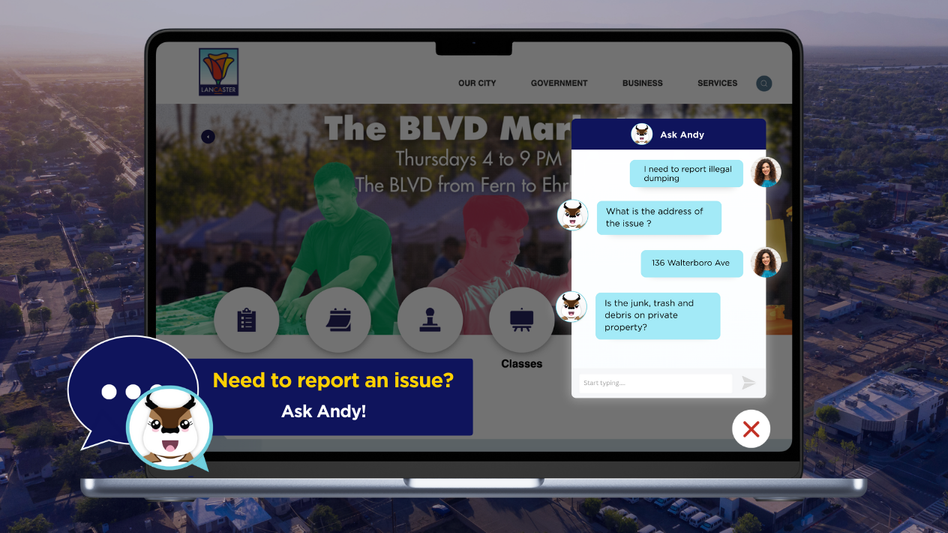
The city wanted technology that could serve all residents, including the many who speak languages other than English at home. Citibot's approach resonated because it promised integration with existing systems, real time translation across 75 languages, and most importantly, a way to augment staff work rather than replace it. Ask Andy, the chatbot, went live on Lancaster's website and opened up entirely new ways for residents to interact with city government. What surprised the team most was not the technology itself, but the organizational change that followed.
RECOMMENDATION ONE: Bring staff in from the start
The biggest internal concern Lancaster faced was straightforward and honest. Staff feared the chatbot would eliminate their jobs. In government, this concern runs deep because many employees measure their value by the work they do, the calls they handle, and the residents they serve. Lancaster addressed this head on by treating staff as partners, not obstacles.
The city asked each department head to nominate a point person, a representative who would help test the chatbot, shape its responses, and serve as the internal champion in their department. These individuals became invested in Ask Andy's success. They tested the system with real questions, flagged errors, and refined answers so they reflected how city staff would actually respond. Training sessions explained not just the mechanics of the tool, but why it was built and how it would change what teams could accomplish.
What shifted everything was when staff saw the chatbot in action. Larissa noted that the initial concern among staff was direct: "Will I be replaced by a bot?" But as implementation progressed and staff began to understand their role in shaping the tool, that fear transformed. "Through collaboration, it went from fear to pride," Larissa observed. Staff began to recognize that answering basic questions is exactly the kind of repetitive work that AI excels at, freeing people to do complex, judgment driven work that requires a human touch.
"What we've realized is that Citibot actually helps augment the things that we do, providing insight into common questions and allowing us to streamline information"
Lancaster noted. A permitting specialist can now spend time guiding residents through complicated applications rather than answering the tenth caller of the day asking where to submit forms. A community services representative can focus on residents with real problems, knowing that Ask Andy is handling the volume of calls about holiday closures and program hours. Patti added a crucial observation: "There wasn't any additional work that our staff needed to do."
For your agency: Before launch, meet with every department head. Show them how many routine questions their team answers each week. Be specific about goals: reducing hold times, extending service access, not cutting staff. Ask for their help in testing and training. Make them agents of change rather than subjects of it. When staff see they are shaping the tool rather than being replaced by it, resistance transforms into advocacy.
RECOMMENDATION TWO: Fix your content problem while implementing the chatbot
Lancaster discovered something crucial during preparation. The chatbot is only as good as the information it draws from, and much of the city's website content was outdated or buried under layers of pages. When Ask Andy ingested the site, it revealed a problem that had been creeping up for years.
"We discovered how outdated our website information was, doing our residents a disservice and creating frustration."
This became an unexpected opportunity. Rather than just launching a chatbot, Lancaster launched a content refresh. The city looked at which pages Ask Andy was pulling from most frequently, which questions appeared most often in chat logs, and where accessibility issues appeared. This data told them exactly where to focus limited resources. A section of the website getting hundreds of duplicate questions in the chatbot became a priority for updating and clarifying language.
Lancaster prioritized pages that drove the most traffic, affected the most residents, and had the most outdated information. The result was a website that worked better for everyone, not just chatbot users. Citibot helped by using AI to flag redundant information, inconsistent tone, and compliance issues across the site automatically. Instead of time intensive manual review, the city got a roadmap for improvements.
For your agency: Do a content audit before or immediately after launching your chatbot. Ask the vendor to show you data on which pages the bot is pulling from most. Treat content refresh as part of implementation, not a separate project. Use the chatbot data to make the case for IT resources to support this work. You will find that stakeholders are more willing to invest in updating a page when they can see it is generating dozens of duplicate calls. The data transforms abstract complaints into concrete evidence.
RECOMMENDATION THREE: Leverage multilingual capability as an equity tool and data source
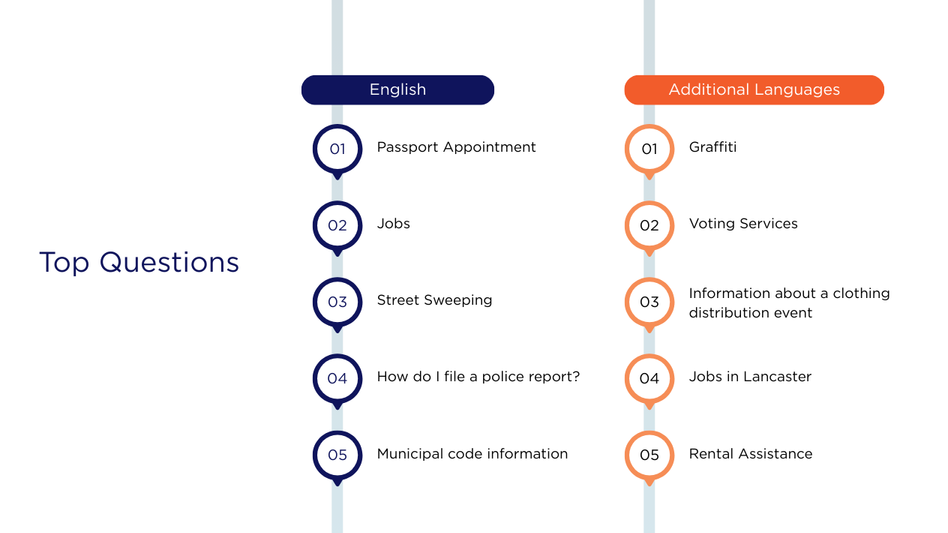
Most frequently asked questions
Lancaster is a diverse city. Residents speak English, Spanish, Armenian, and dozens of other languages at home. Historically, the ability to serve those residents in their preferred language depended on hiring bilingual staff or scrambling to find translation services, both resource intensive and imperfect solutions.
Citibot's real time translation across 75 languages changed this entirely. Residents can now type in Spanish, Armenian, or any of dozens of other languages, and Ask Andy responds in that language, including official documents and PDFs. The city does not need translators on staff. The content stays in English on the backend, but residents access it in their own language instantly. This is not just a convenience, it is a commitment to equity in action.
"This transformation has empowered City of Lancaster residents to access vital information anytime, alleviating common frustrations and ensuring better service delivery."
The data from this capability is equally valuable. The city can now see which languages residents are using to interact with city services. If a spike occurs in Armenian language queries about a particular service, that tells them they need to ensure materials in that language and possibly adjust how they reach out to that community. Lancaster discovered gaps in service accessibility they did not even know existed. The multilingual data became a lens through which to see their own community composition and service gaps.
For your agency: Make sure multilingual support is a priority from day one, not a phase two feature. Ask your vendor to show you language usage data in your community so you can understand where the need is greatest. Use this data when presenting to your council and community about digital equity. Multilingual residents notice immediately when the government starts speaking their language, and it builds real trust. The equity argument is compelling; the data argument is decisive.
RECOMMENDATION FOUR: Build data governance into your operations
One of the most powerful aspects of Ask Andy has been the data it generates about resident behavior and city service gaps. Every question asked, every language spoken, every time of day a resident reaches out, all of this becomes a permanent record of community needs in action. This is civic data at its most granular and honest.
Lancaster now tracks questions by volume, language, and category. This data has driven decisions about everything from website updates to community outreach campaigns. When the city sees large numbers of residents asking about a specific program in multiple languages, that tells them their outreach is insufficient or their program pages are confusing. When the volume of after hours requests for a particular service spikes, that signals where they might need to extend hours or automate more functions.
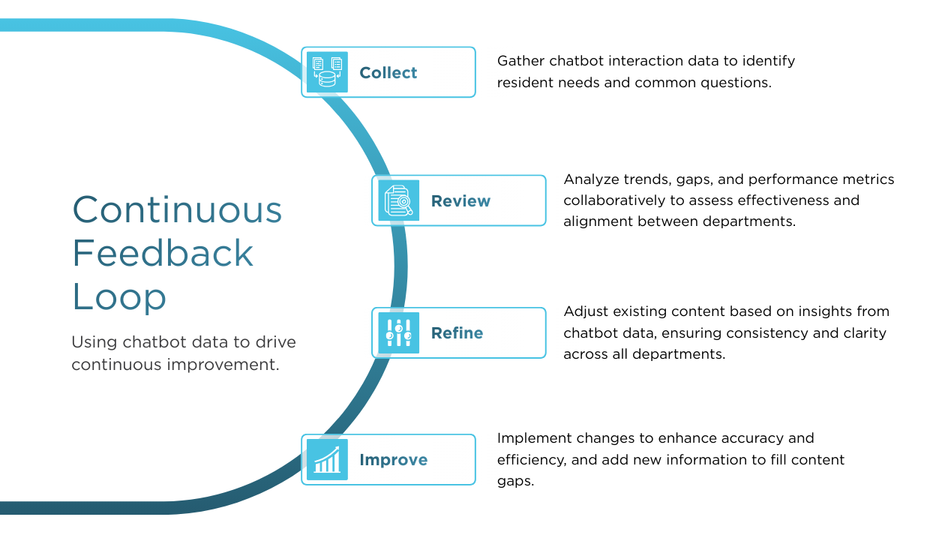
The key is building this into regular operations. Do not treat chatbot data as a one off report that sits in a folder. Have someone responsible for reviewing it monthly. Share summary findings with department heads so they understand how their services look from the resident perspective.
"Understanding what residents want to know, when, and how they ask about it is crucial for driving data governance and proactive service delivery." Use the data to make the case for content updates, staffing changes, and budget priorities.
RECOMMENDATION FIVE: Design the rollout to show quick wins
When Lancaster launched Ask Andy, the team did not expect overnight transformation, but they did expect to see results that mattered to staff and residents quickly. The city focused its initial rollout on the highest volume service areas, the ones where residents call most often with straightforward questions.
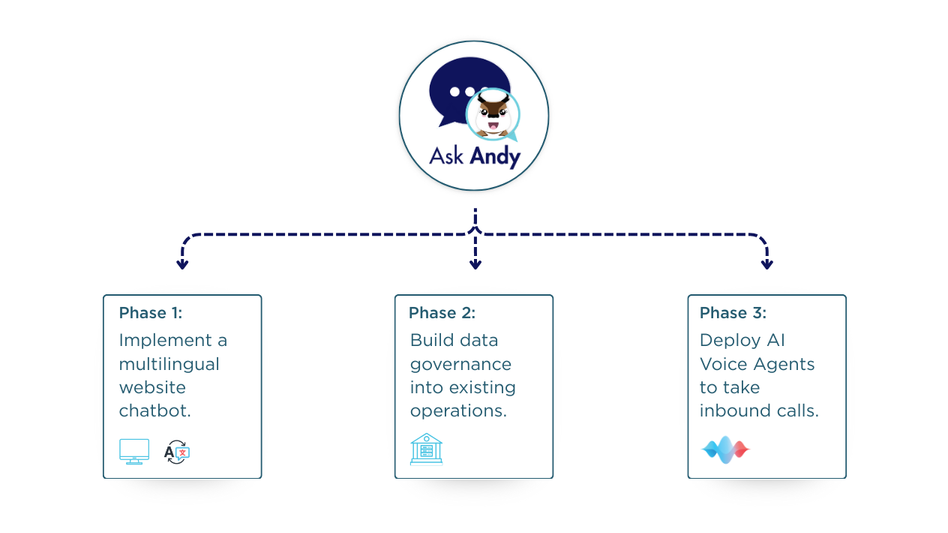
Phase breakdown for Ask Andy
Permitting, park hours, trash collection, facility hours, event information, these became the initial focus for Ask Andy. The city wanted staff in these areas to see immediate relief from the volume of routine inquiries. They wanted residents to experience the difference of getting an instant answer at 9 p.m. on a Saturday rather than waiting until Monday morning. Both constituencies needed to feel the value early. The phased approach worked. After the first few weeks, when staff and residents could see the benefit, Ask Andy's reach expanded across more departments and more complex services. This built momentum and gave the team time to refine responses and resolve issues.
For your agency: Launch with your highest volume, most straightforward services first. Show quick wins. Let word of mouth build enthusiasm. Do not try to integrate every system on day one. Give staff a few weeks to see the benefit before asking them to feed data into the chatbot or change their workflows. This phased approach builds trust and momentum for the harder work ahead. The psychology of early success matters more than you might think.
What comes next for Lancaster and the broader opportunity
Lancaster is excited about the possibilities ahead. The city is exploring deeper integration with its service request system so residents can not only ask questions but submit permits and service requests directly through Ask Andy. The team is testing voice capabilities so residents can call a city number and talk to Ask Andy in natural language, with complex questions routed to staff automatically. They are expanding to text messaging so residents who prefer that channel can reach the city there too. Each extension starts with the same principle: meet residents where they are, in the way they prefer to communicate.
The real success at Lancaster has not been the technology itself, but how it has changed the relationship between the city and its residents and among city staff. Lancaster is more responsive. The city is more equitable in how it serves people who speak different languages. Information gaps are clearer and easier to address. The city is building a culture where data about residents shapes how decisions are made. That culture shift is what matters most.
FOR YOUR AGENCY: The blueprint and why it works
The Lancaster blueprint is not a rigid plan but an invitation. Every government agency has its own constraints, culture, and community. But the core ingredients visible here are within reach of any city or county ready to let AI help deliver on the ambitious ideas that residents and councils bring to the table.
Start with your people. Bring staff in from the start. Make them agents of change, not subjects of it. Fix your information. Let resident questions guide content updates and priorities. Put equity at the center. Multilingual support is not nice to have, it is how you serve all residents. Measure what matters. Use the data to understand your community and justify investment. Let quick wins build momentum. Do not try to do everything on day one.
If Lancaster can do this in a city of 170,000 with finite resources and all the complexity that comes with government work, your city can too. The wild ideas your council has about serving residents better are only as good as the people and systems you put behind them. Citibot helped Lancaster build that foundation. We hope this paper helps you build yours.
The future of government is not about replacing staff with technology. It is about giving staff better tools to focus on the work that matters most: serving residents with dignity, accessibility, and responsiveness. That is the promise of AI resident engagement done right. That is what Lancaster is proving is possible.